


Educational
How to Sell or Transfer a Suppressor in 2026
How you sell a suppressor in 2026 depends on your state and whether the suppressor is registered. Since October 9, 2026, ATF no longer enforces Form 4 approval for suppressor transfers, so in a free state a sale runs like any firearm sale. In an NFA state, the seller still files a Form 4 at a $0 tax and waits on ATF.
The simplest route anywhere is selling to a dealer. You might net less, but the dealer takes ownership and handles the next buyer.
What are your options for selling a suppressor?
Very few owners ever sell a suppressor. When one does, the easiest route is back to the dealer they bought it from. Your dealer will often take it back for credit toward something else.
Beyond that, a suppressor has four ways out: sell it outright to a dealer, consign it with a dealer, sell it privately to a buyer in your state, or sell it to a buyer in another state through a dealer in that state.
Which paperwork each one takes comes down to the buyer’s state and whether the suppressor is registered in ATF’s National Firearms Registration and Transfer Record (NFRTR), the federal NFA registry.
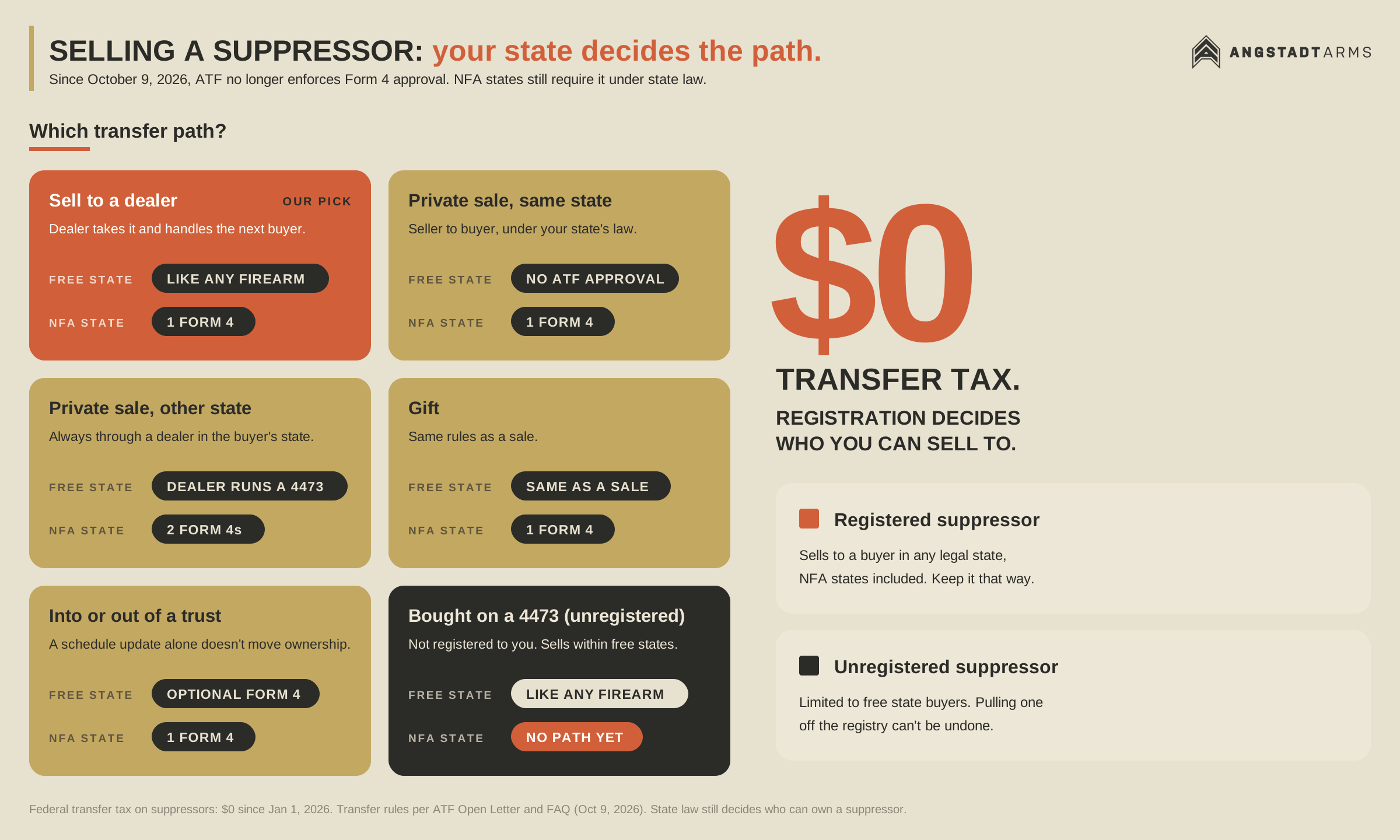
Every suppressor sale comes down to the buyer’s state and the suppressor’s registration. In an NFA state, the new owner still takes possession only after ATF approves a Form 4.
What changed for suppressor sales on October 9, 2026?
ATF stopped enforcing the NFA’s approval and registration requirements for suppressors. That covers transfers too: ATF no longer requires an approved Form 4 before a suppressor changes hands, and it won’t enforce the ban on moving an unregistered suppressor across state lines. Registration is now voluntary. Our post on ATF’s NFA Open Letter covers the full change.
Two sets of rules still apply. State law decides who can own a suppressor and, in the 15 NFA states, still requires the Form 4. The Gun Control Act still treats a suppressor as a firearm, so a sale to someone in another state goes through a dealer in the buyer’s state, and you can’t sell to anyone you know or have reason to believe is prohibited from owning one.
Since October 9, 2026, federal law no longer requires a Form 4 to sell a suppressor. State law and the Gun Control Act still set the rules for who can buy it and how.
Why sell a suppressor to a dealer instead of a private buyer?
Because the dealer takes ownership before anyone else gets involved. In a free state, the dealer takes the suppressor in like any other firearm. In an NFA state, you file one Form 4 to the dealer, ATF approves it, and your part is done. Either way, the dealer finds the next buyer and runs that buyer’s paperwork.
A private sale usually nets more money, and that’s the tradeoff. In exchange, you vet a stranger, confirm they can legally own a suppressor, and handle the paperwork your state requires. For most owners, the difference isn’t worth it.
Consignment sits in between. A dealer markets the suppressor for you, which can bring a better price than a straight sale, but you wait until it sells.
Selling to a dealer may net less money, but the dealer takes ownership and handles the next buyer. It’s the cleanest way out of a suppressor you don’t want, in any state.
How does a private suppressor sale work in the same state?
In a free state, federal law now treats it like a private sale of a rifle within your state. ATF no longer requires a Form 4 or approval. Your state may still require a dealer or a background check for private sales, so check before you hand it over.
In an NFA state, nothing changed. The seller files a Form 4 naming the buyer, the buyer supplies fingerprints and photos and notifies their chief law enforcement officer, and the tax line is $0. The suppressor stays with the seller until ATF approves the transfer. Our guide to how long ATF approval takes covers the current wait.
If your suppressor is registered, a free state private sale leaves one loose end: the registry still lists you. ATF’s guidance doesn’t say how a private seller updates that record. The clean ways to hand off a registered suppressor are a voluntary Form 4 to the buyer, which keeps it registered in the buyer’s name, or a sale through a dealer.
A gift follows the same rules as a sale.
In a free state, a same-state private sale runs like any firearm sale under your state’s law. In an NFA state, it still takes an approved Form 4 at a $0 tax.
How do you sell a suppressor to someone in another state?
Through a licensed dealer in the buyer’s state. That rule comes from the Gun Control Act, and the Open Letter didn’t change it. What happens at that dealer depends on where the buyer lives.
If the buyer is in a free state, you ship the suppressor to their dealer, and the dealer transfers it on a Form 4473 and a NICS background check. If the buyer is in an NFA state, the suppressor has to be registered. You file a Form 4 to the dealer, ship it after approval, and the dealer files a second Form 4 to the buyer.
Before 2026, each of those Form 4s carried a $200 tax, so an interstate sale cost $400 in stamps alone. Both are $0 now.
Confirm the buyer can legally own a suppressor in their state before you list it. State law still decides who can own one, and the Silencer Shop ruling and ATF’s October 9 policy only changed the paperwork in the free states. Our Silencer Shop ruling explainer and suppressor legal states map show where each state lands.
An out-of-state sale always goes through a dealer in the buyer’s state. A free state buyer picks it up on a 4473. An NFA state buyer needs a registered suppressor and two approved Form 4s.
Does registration change who you can sell a suppressor to?
Yes. A registered suppressor can go to a buyer in any state where suppressors are legal, including the 15 NFA states, because it can move on a Form 4.
A suppressor that isn’t registered to you is harder to place. ATF says an item removed from the registry can’t be registered again unless the Attorney General declares an amnesty, and ATF can’t say whether a state treats an unregistered suppressor as lawfully held. Whether one can ever reach a buyer in an NFA state is a question ATF hasn’t answered.
If there’s any chance you’ll sell, keep your suppressor registered. It costs nothing at a $0 tax, and it keeps every legal buyer in play.
A registered suppressor can sell to a buyer in any legal state. One that isn’t registered is effectively limited to free state buyers, so keep yours registered if you might sell.
Can you move a suppressor into or out of a gun trust?
Yes. In an NFA state, moving a suppressor from your name to a trust, or from a trust back to you, is a transfer and takes a Form 4, just like a sale. Adding the suppressor to the trust schedule doesn’t change ownership by itself.
In a free state, federal law no longer requires that Form 4. A voluntary one still keeps the registry matching who owns the suppressor, which matters if the trust ever sells to a buyer in an NFA state. Our NFA trust vs individual comparison covers the tradeoffs.
Passing a suppressor to an heir after the owner dies runs on a different form, the tax-exempt ATF Form 5, and gets its own guide.
Moving a suppressor between your name and a trust takes a Form 4 in an NFA state. In a free state it’s optional, and a voluntary Form 4 keeps the registry current.
Can you sell a suppressor bought on a Form 4473?
Yes, within the free states. A suppressor bought on the 4473 path after the August 2026 Silencer Shop ruling isn’t registered to you, and since October 9, 2026, ATF treats it like any other firearm for transfers. A same-state private sale under your state’s law works, and so does a sale to a free state buyer through a dealer in their state.
Selling it to a buyer in an NFA state is the open question. That buyer’s state requires a registered suppressor, and ATF hasn’t said how an unregistered one gets there. Start with the dealer that sold it to you.
A suppressor bought on the 4473 path sells like any firearm within the free states. Selling it into an NFA state has no documented path yet.
Can you sell a 10/22 with a Vanquish 22 barrel installed?
Sell the rifle, keep the barrel. On a Vanquish 22 build, the integrally suppressed barrel is the suppressor, not the rifle. Pull the Vanquish 22, put the factory barrel back in, and the rifle sells like any other 10/22.
The Vanquish 22 itself sells like any suppressor, on the rules above for your state and the buyer’s, and drops into the next owner’s 10/22.
On a Vanquish 22 build, the barrel is the suppressor. Remove it and the 10/22 sells like any rifle, while the Vanquish 22 follows the suppressor rules.
| Situation | Free state | NFA state |
|---|---|---|
| Sell to a dealer | Dealer takes it in like any firearm | Form 4 to the dealer, then hand off after approval |
| Private sale, same state | Private sale under your state’s law, no ATF approval | Form 4 to the buyer, then hand off after approval |
| Private sale, other state | Ship to a dealer in the buyer’s state, who transfers on a 4473 | Registered suppressor only: Form 4 to a dealer in the buyer’s state, then Form 4 to the buyer |
| Gift | Same as a private sale | Form 4, same as a sale |
| Your name to a trust, or back | Optional Form 4 | Form 4 |
| To an heir after death | Covered in the estate planning post | Form 5 (tax-exempt) |
| Bought on a Form 4473 (unregistered) | Sells like any firearm | No documented path yet |
The cleanest way to sell a suppressor
Sell it to a dealer, or take it back to yours for credit. It works in every legal state, and the dealer handles the next buyer’s paperwork.
If your suppressor is registered, keep it that way until it’s sold. Registration is what lets the next buyer live in any state where suppressors are legal.
Buy it once and keep it
Most owners never sell a suppressor, because the right one stays on the gun. The Reticent 22 is the lightest full-size .22 suppressor at 2.5 ounces, Grade 5 titanium that threads onto any 1/2×28 rimfire host and meters as low as 113.4 dB. Want a dedicated quiet 10/22 instead? The Vanquish 22 replaces the factory barrel with an integral suppressor and is the only fully rifled .22 LR suppressor.
Download the free guide now!
From choosing your first suppressor to taking it home, this guide walks you through everything. Don't be caught off guard, enter your email and we'll send it straight to your inbox!
Featured Products
-
 Vanquish 22 Suppressed Ruger 10/22 Barrel
Original price was: $599.00.$535.00Current price is: $535.00.
Vanquish 22 Suppressed Ruger 10/22 Barrel
Original price was: $599.00.$535.00Current price is: $535.00. -
 Reticent 360S Suppressor
Original price was: $895.00.$795.00Current price is: $795.00.
Reticent 360S Suppressor
Original price was: $895.00.$795.00Current price is: $795.00. -
 Reticent 22 Suppressor
Original price was: $375.00.$345.00Current price is: $345.00.
Reticent 22 Suppressor
Original price was: $375.00.$345.00Current price is: $345.00.
Frequently asked questions
No. The federal transfer tax on suppressors has been $0 since January 1, 2026, and since October 9, 2026, ATF no longer enforces Form 4 approval for suppressor transfers. In the 15 NFA states, state law still requires an approved Form 4 before the new owner takes possession.
Yes, if the buyer lives in your state and can legally own a suppressor. In a free state, it works like a private rifle sale under your state’s law. In an NFA state, the seller files a Form 4 naming the buyer, who takes the suppressor only after ATF approves it.
Only through a licensed dealer in the buyer’s state. A free state buyer picks it up on a Form 4473 and a NICS check. If the buyer lives in an NFA state, the suppressor must be registered and moves on two Form 4s: seller to dealer, then dealer to buyer.
No. Angstadt Arms sells new suppressors only and does not take trade-ins. To sell a suppressor you no longer want, start with your dealer. Many dealers will buy it outright or take it in for store credit, and the dealer handles the next buyer’s paperwork.
Yes, to a buyer in a free state. Since October 9, 2026, ATF treats it like any other firearm for transfers, so a same-state private sale or a sale through a dealer works under state law. Selling it to a buyer in an NFA state has no documented path yet.
Latest Intel
How to Sell or Transfer a Suppressor in 2026
Oct
First Round Pop: What Causes It and How to Get Rid of It
Oct
ATF’s NFA Open Letter: Do Suppressors Still Need to Be Registered?
Oct
10/22 Takedown Suppressor: The Quiet Build That Packs Small
Oct
Top 7 Suppressor Myths, Debunked
Oct
DOJ Won’t Appeal the NFA Ruling: What It Means for Buyers
Oct