


Educational
How Quiet Is a Suppressed .22 LR? Decibel Levels Compared

A suppressed .22 LR meters around 113 to 128 decibels with subsonic ammo, down from roughly 140 and up unsuppressed. That drop is real and you feel it on the first shot, but it’s not “Hollywood silent”, and the number does not mean what a chart of everyday sounds makes it look like.
A suppressor’s decibel rating is a peak impulse reading, the height of the pressure spike from a single shot, not the steady level of a lawn mower running beside you. Getting that straight is the difference between a realistic expectation and getting sold a number that was never measured the same way twice.
How many decibels is a suppressed .22?
With a quality suppressor and subsonic ammo, a .22 LR typically meters in the low 110s to upper 120s in decibels at the muzzle. Unsuppressed, the same shot runs around 140 decibels and up. So a good suppressor pulls roughly 20 to 30 decibels off the shot, and because decibels are logarithmic, that is a large cut in the actual pressure your ear takes.
Call it 110 to 128 decibels suppressed on subsonic ammo, versus 140 and up unsuppressed. The exact figure depends on the host, the ammo, and how the test was run.

What does a suppressor’s decibel number actually measure?
Peak impulse, not sustained volume. A gunshot is a single, violent pressure spike that lasts a few milliseconds, and the meter captures the height of that spike, written as LApeak. The decibel chart you have seen for everyday sounds measures something else: noise that holds steady, like traffic or a blender, averaged over time and written as dBA.
That is why you cannot set a gunshot number next to a lawn mower number and call them equal. Impulse noise does more damage at the same reading than steady noise does, which is why the danger line for a single impulse sits up around 140 decibels. A suppressed .22 at 115 decibels is not “as harmless as a blender at 115.” It is a spike, and a spike plays by different rules.
How loud is an unsuppressed .22 to begin with?
Louder than people expect for such a small round. An unsuppressed .22 LR runs about 140 decibels and up at the muzzle, the same impulse range the National Institute on Deafness and Other Communication Disorders assigns to fireworks, 140 to 160 decibels. That is the level where a single exposure can start causing permanent hearing damage, no repetition required.
Small caliber does not mean quiet. An unsuppressed .22 is already in hearing-damage territory on the very first round.
Is a suppressed .22 actually hearing safe?
Quieter, yes. Automatically safe, no. A suppressed .22 in the 110 to 128 range is far easier on your ears than a bare muzzle, and plenty of shooters run one comfortably outdoors without plugs. But steady noise at 110 decibels can start damaging hearing in about two minutes, and a suppressed shot is still an impulse on top of that. The CDC and NIOSH set the recommended limit at 85 dBA over a workday, so anything at the range is worth respecting.
The honest version: suppression moves a .22 from “you must protect your hearing” to “you should still protect your hearing, and it is a lot more forgiving if you skip it.” A suppressor buys you a wide margin, not a free pass. Outdoors on subsonic ammo it is genuinely hearing friendly. Indoors, or in volume, wear protection anyway.
How quiet is the Reticent 22, specifically?
The Reticent 22 is the quietest and lightest full size .22 suppressor. On a .22 LR bolt gun with subsonic ammo it meters 113.4 decibels under MIL-STD-1474D, taken one meter to the left of the muzzle on a Larson Davis meter. That sits at the quiet end of the entire rimfire class, and it gets there while being just 2.5 ounces.
Full size sound reduction at mini suppressor weight is the whole point of the Reticent 22: quiet on the meter and light enough that it does not change how the rifle handles. The why behind the weight is in our breakdown of Grade 5 titanium and DMLS.
How quiet is the Vanquish 22, and why does standard ammo matter?
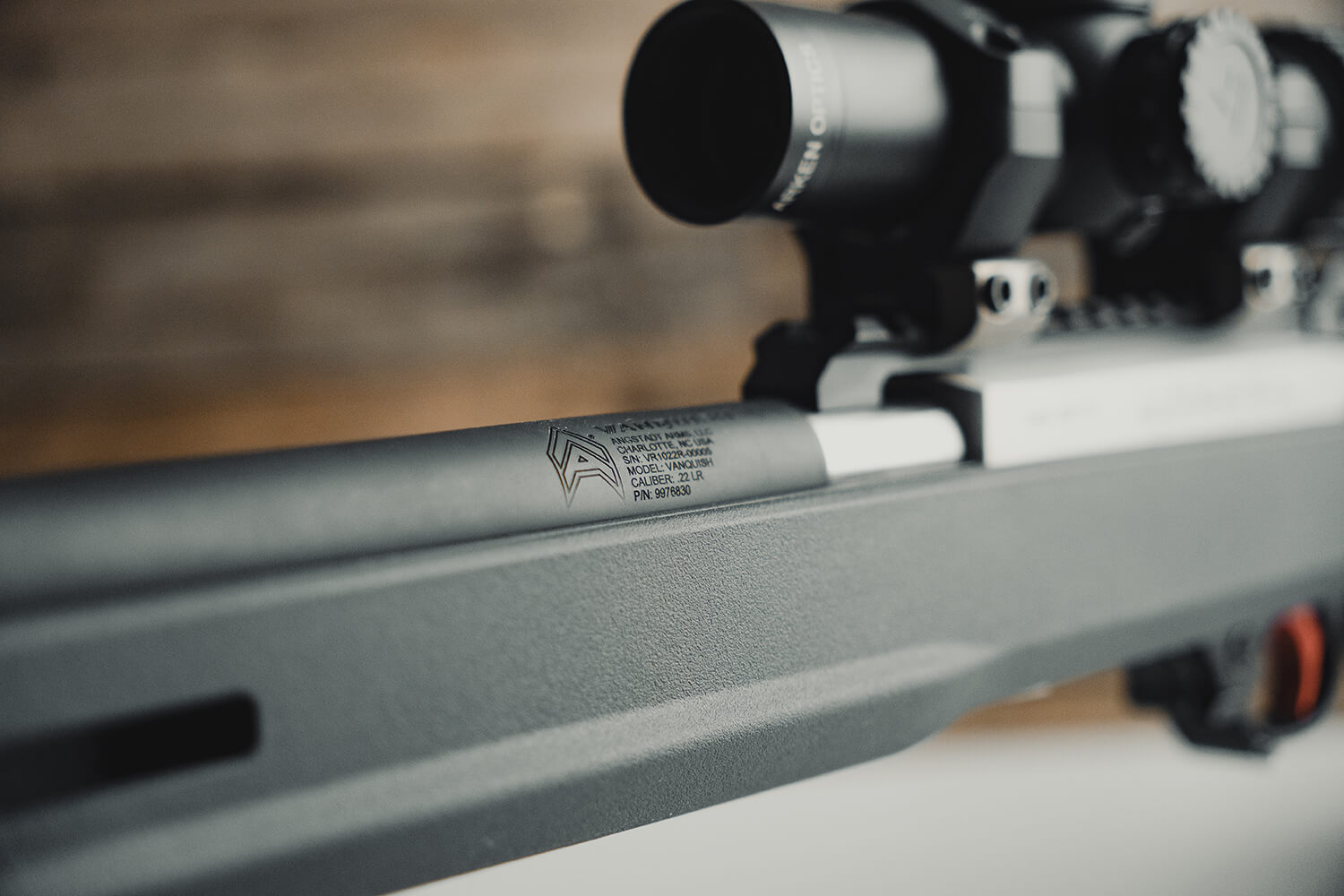
The Vanquish 22 has no baffles and quiets the shot by playing the volume game. It is an integrally suppressed replacement barrel for the Ruger 10/22 that vents gas along its length, so standard velocity ammo leaves the muzzle subsonic and never cracks. Reviewers have put it near the top of the rimfire field: Lynx Defense found that on CCI subsonic the loudest sound at the bench was the bolt cycling, not the shot, and RECOIL, testing it against a threaded barrel and a standalone suppressor, found the Vanquish noticeably quieter.
Truth be told, the thread on Reticent 22 reads quieter on paper. What the Vanquish adds is quiet on cheap, standard ammo like Remington Thunderbolt, with nothing hanging off the muzzle and a full match barrel behind it. The Reticent wins the meter, the Vanquish wins on standard ammo and on accuracy. The full build is in our integrally suppressed 10/22 guide.
Why do two suppressors at the same decibel number sound different?
Because peak decibels only measure the height of the spike, not its pitch or how sharp it lands on your ear. Two suppressors can post the same number and sound clearly different, one a flat thud, the other a harder crack. The reading that looks identical on paper can feel a grade quieter in person, which is why tone belongs in the conversation alongside the number. More on how the measurement works in our guide to the quietest .22 suppressor.
Why does the same suppressor post different numbers in different tests?
Barrel length, ammo, first round pop, cooling time between shots, and exact meter placement all move the reading. The same suppressor reads one number on a pistol and another on a rifle, one number on bulk ammo and another on match subsonic. Independent third party testing at the Thunder Beast Silencer Summit has put the quietest rimfire suppressors in the mid 110s at the muzzle, which lines up with where a good .22 setup lands. Only compare numbers measured the same way. A figure with no host, ammo, and protocol attached is a claim, not a measurement.
Suppressed .22 decibels versus sounds you already know
Here is where a suppressed .22 lands against everyday noise and the hearing-risk thresholds behind those numbers. Everyday sounds are sustained levels (dBA); gunshot figures are peak impulse. They are not measured the same way, but both belong on the protect-your-hearing side of the chart.
| Sound | Approx. level | Hearing risk |
|---|---|---|
| Safe daily average | 70 dBA or lower | No action needed |
| Lawn mower, vacuum, power tools | 85 to 90 dBA | Protect your hearing; damage builds over hours |
| Chainsaw, siren, concert | 95 to 110 dBA | Damage in minutes |
| Suppressed .22 LR, subsonic ammo (peak impulse) | ~110 to 128 dB | Quieter, but still protect your hearing |
| Reticent 22, measured (peak impulse) | 113.4 dB | Quiet end of the rimfire class |
| Unsuppressed .22 LR (peak impulse) | ~140 dB and up | Immediate risk on the first shot |
| Fireworks | 140 to 160 dBA | Immediate risk |
Everyday-sound levels and hearing thresholds are from the CDC/NIOSH and the National Institute on Deafness and Other Communication Disorders. Gunshot figures are peak impulse readings; the Reticent 22 number is Angstadt’s own measurement under MIL-STD-1474D.
- Suppressed and subsonic pulls a .22 from 140 and up down to roughly 110 to 128 decibels.
- That number is a peak impulse spike, not the sustained level of an everyday-sounds chart.
- Quieter is not the same as safe. Outdoors on subsonic it is hearing friendly; still protect your hearing indoors or in volume.
- Tone and test conditions matter as much as the raw decibel figure.
Quiet you can appreciate
The Reticent 22 is a 2.5oz thread on suppressor that meters 113.4 decibels and moves across any 1/2×28 rimfire you own, all for just $345. Interested in going quiet? See our guide to buying a suppressor online.
Featured Products
-
 Reticent 22 Suppressor
Original price was: $375.00.$345.00Current price is: $345.00.
Reticent 22 Suppressor
Original price was: $375.00.$345.00Current price is: $345.00.


Frequently asked questions
With a quality suppressor and subsonic ammo, a .22 LR meters around 110 to 128 decibels at the muzzle, down from roughly 140 and up unsuppressed. That is a large cut, because decibels are logarithmic. The exact figure depends on the host, the ammo, and how the test was run.
Outdoors on subsonic ammo, a suppressed .22 is genuinely hearing friendly, and many shooters run one without plugs. It is not automatically safe, though. At 110 to 128 decibels it is quieter and far more pleasant, but indoors or in volume you should still protect your hearing.
About 140 decibels and up at the muzzle, the same impulse range the CDC assigns to fireworks. That is the level where a single exposure can cause permanent hearing damage, so even a small rimfire round is already in dangerous territory on the first unsuppressed shot.
Not always. Peak decibels measure the height of the pressure spike, not its pitch or how sharp it feels at the ear. Two suppressors can share the same reading yet sound clearly different, so tone and the character of the report matter alongside the raw number.
Pair a quality suppressor with subsonic ammo. Subsonic .22 stays below the speed of sound, so there is no sonic crack for the suppressor to fight, leaving only the muzzle blast. That combination gets you the lowest real world sound, whatever a spec sheet claims.
Latest Intel
Who Can Use Your Suppressor? Rules for Family & Friends in 2026
Oct
Suppressed Fest 2026 Recap
Oct
Vanquish 22 M81 Woodland Limited Ed: Available Now
Oct
Is the Ruger Precision Rimfire Discontinued?
Oct
Suppressed Fest 2026: This Weekend!
Oct
How to Sell or Transfer a Suppressor in 2026
Oct