


Educational
Ruger 10/22 & Mark IV Suppressor Alignment
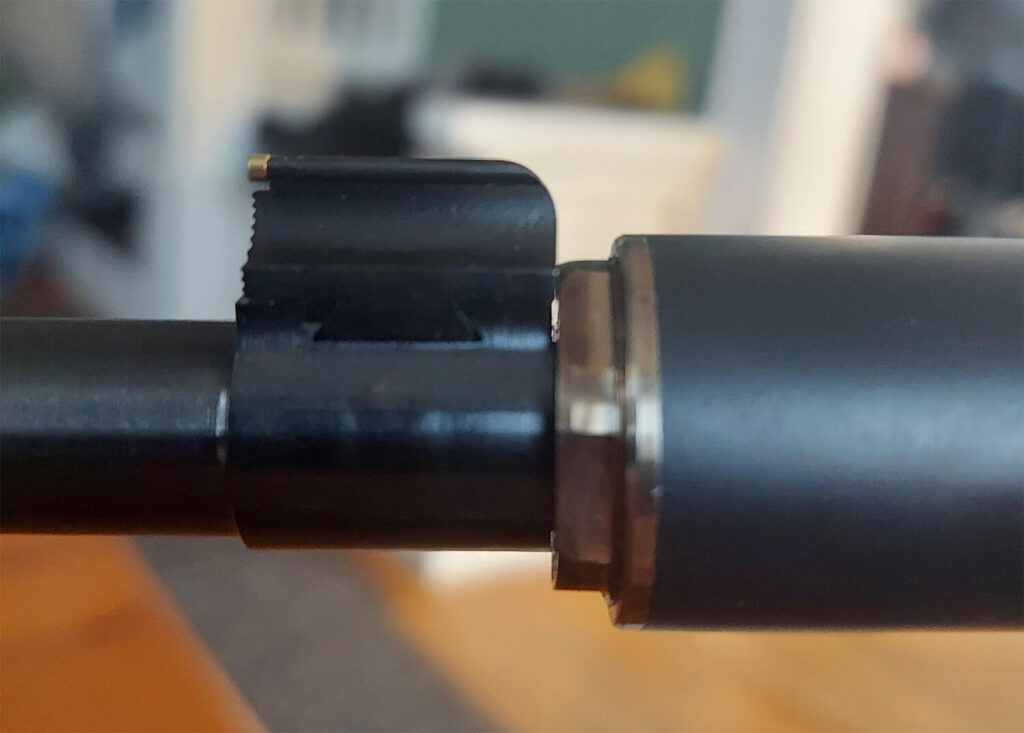
On some factory-threaded Ruger 10/22 rifles and Mark IV pistols, the front sight sits a few thousandths of an inch proud of the barrel shoulder. The suppressor seats against the sight instead of the shoulder, tilts nose-down, and can cause a baffle strike. Check every suppressor with an alignment rod before you fire it, and fix the barrel if the rod drags.
We’ve seen this in our own Reticent 22 warranty claims. The suppressors come back with baffle strikes, and the cause traces to the host barrel. The 10/22 is the rifle we see it on most, followed by the Ruger Mark IV pistol, but any host can do the same thing.
What causes suppressor misalignment on a Ruger 10/22?
A direct thread suppressor is not aligned by its threads. Threads have clearance by design, so they hold the suppressor on without centering it. Alignment comes from the flat rear face of the suppressor seating flush against the barrel shoulder, the square step where the threads begin.
On factory-threaded 10/22 barrels with a front sight, the sight base sits right at the muzzle. If the front of the sight sticks out even slightly past the shoulder, the suppressor hits the sight first. The top of the suppressor stops early, the bottom keeps turning, and the whole suppressor tilts nose-down.
The overhang is tiny, often just .009″, and that’s all it takes to move the bore of the suppressor off the bore of the barrel.
The barrel shoulder aligns a suppressor, not the threads. If anything stops the suppressor before it seats on the shoulder, it sits crooked.
Is this a new problem on the Ruger 10/22 & Mark IV?
No. A Ruger Forum member documented it in October 2016 on two factory-threaded 10/22 Takedown barrels, one stainless and one blued. With his suppressor on, the stainless rifle hit about 18″ low at 50 meters with poor groups, and both barrels showed the suppressor canted downward. A friend’s threaded 10/22 with no front sight mounted a suppressor straight.
In April 2026, a Rimfire Central member found the same thing on a brand-new 10/22: his alignment rod touched the suppressor’s front end cap. When he called Ruger, customer service told him they had seen the issue before and offered to take the rifle back for review.
In the same thread, another owner reported the same front sight overhang on a Ruger Mark IV Target pistol.
Owners have reported this on factory-threaded Ruger barrels for a decade, on the 10/22 and the Mark IV Target.
Why does a misaligned suppressor matter?
A tilted suppressor puts its bore off the bullet’s path. With enough tilt, the bullet clips the front end cap or a baffle on the way out. That’s a baffle strike: it damages the suppressor and can throw the shot.
Short of a strike, misalignment still shows up on paper. The 2016 owner’s rifle shot about 18″ low at 50 meters with the suppressor tilted. Once the suppressor seated flush on the shoulder, he measured zero point of impact shift at 50 meters.
Every suppressor moves point of impact a little, so you should always zero after installing one. A big shift, especially a consistent drop, is a sign the suppressor isn’t seated straight.
A large, low point of impact shift with a suppressor on is a red flag. Check alignment before the next shot.
How do you check suppressor alignment on a Ruger 10/22 & Mark IV?
Use an alignment rod, a precision rod sized to the bore that shows whether the suppressor’s bore and the barrel’s bore line up. The check takes about two minutes.
- Unload the rifle and lock the bolt open.
- Thread the suppressor on until it seats.
- Drop a .22 caliber alignment rod through the front of the suppressor and into the barrel.
- The rod should slide in freely and sit centered in the end cap hole.
- If the rod touches the end cap or won’t go in, the suppressor isn’t aligned. Don’t fire it.
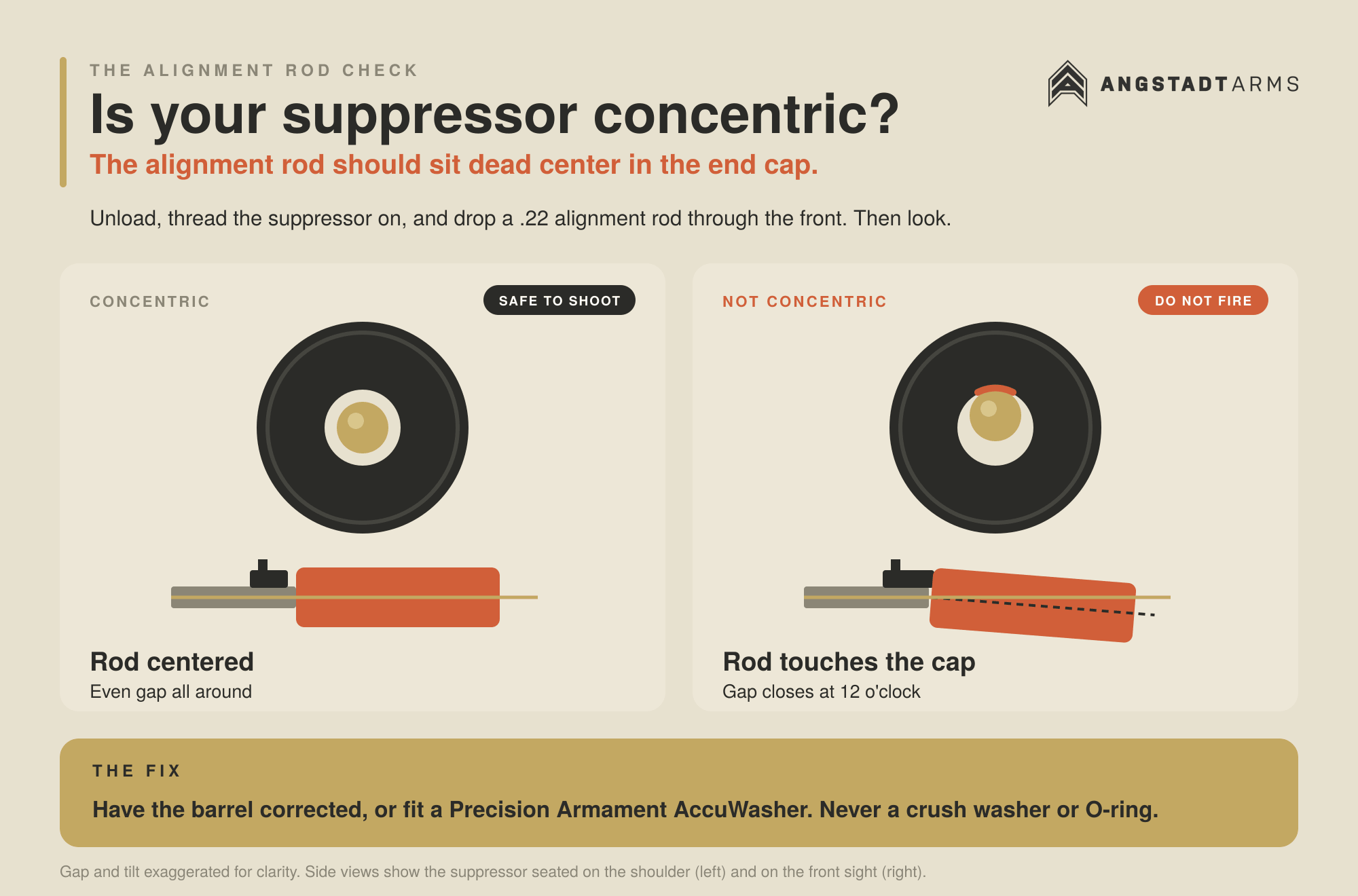
No rod? Pull the barrel with the suppressor installed and look down the bore from the chamber end. You should see a full circle of light with no part of the end cap showing. A crescent of the end cap at the top of the bore means the suppressor is tilted down.
Check every suppressor on every host the first time you mount it, and again any time the barrel or suppressor changes.
An alignment rod check takes two minutes. A baffle strike takes a repair.
How do you fix a misaligned suppressor on a Ruger 10/22?
We recommend two fixes.
Have the manufacturer or a gunsmith correct the barrel. This is the best option. Either one can face the front of the sight base back behind the shoulder, or recut the shoulder square to the bore, so the suppressor seats on the barrel the way it was designed to. That fixes the rifle for every suppressor you put on it.
Fit a Precision Armament AccuWasher. The AccuWasher Gen 2 is a single precision-machined steel shim that sits on the barrel shoulder and gives the suppressor a flat, square face to seat against, ahead of the sight. Precision Armament makes kits for the 1/2×28 rimfire thread in several outside diameters. Install it chamfered side against the shoulder, per their instructions, and recheck with an alignment rod.
Never use a crush washer or an O-ring. They compress, shift, or add their own error, and a suppressor needs a flat, rigid face to seat against.
Some owners file the sight down themselves. That permanently changes your rifle, so we’d rather you hand it to the manufacturer or a gunsmith to correct.
| Fix | What it does | Changes the rifle? | Our take |
|---|---|---|---|
| Manufacturer or gunsmith correction | Faces the sight base back or squares the shoulder to the bore | Yes | Recommended (best option) |
| Precision Armament AccuWasher Gen 2 | A single precision shim gives the suppressor a square seat ahead of the sight | No | Recommended |
| Crush washer or O-ring | Spacer that can compress or shift | No | Never |
Fix the seat, not the symptom: have the barrel corrected or fit an AccuWasher. Never a crush washer or O-ring.
Is a baffle strike covered by the Reticent 22 warranty?
Yes. A baffle strike on a Reticent 22 is covered under our warranty.
The suppressor isn’t the cause. We check 100% of our suppressors for concentricity as soon as we cut the threads, so every Reticent 22 leaves the factory aligned. A baffle strike is caused by the barrel or the host firearm.
Warranty fixes the suppressor. It doesn’t fix the barrel that caused the strike, so the same host will do it again. Confirm concentricity before the first shot and you skip the whole problem.
A baffle strike is covered, but the barrel that caused it stays crooked until you fix it. Check first.
Which hosts should you check?
Every one. A direct thread suppressor like the Reticent 22 moves gun to gun on any 1/2×28 rimfire host, so give each new host its own concentricity check.
New host, new concentricity check. Every time.
What should you do before your first suppressed shot?
Use an alignment rod to check every suppressor on every host. If the rod drags on a factory-threaded 10/22 or Ruger Mark IV, the front sight is likely holding the suppressor off the shoulder. Have the manufacturer or a gunsmith correct the barrel, or fit a Precision Armament AccuWasher, then recheck before you shoot.
Download the free guide now!
From bare receiver to backyard-quiet, this guide walks you through every part of a suppressed 10/22 build. Skip the guesswork, enter your email and we'll send it straight to your inbox!
Featured Products
-
 Reticent 22 Suppressor
Original price was: $375.00.$345.00Current price is: $345.00.
-
 Vanquish 22 Suppressed Ruger 10/22 Barrel
Original price was: $599.00.$535.00Current price is: $535.00.
-
 Vanquish 22TD Suppressed Ruger 10/22 Takedown Barrel
Original price was: $599.00.$535.00Current price is: $535.00.
Frequently asked questions
On some factory-threaded Ruger 10/22 barrels, the front sight sits slightly proud of the barrel shoulder. The suppressor seats against the sight instead of the shoulder and tilts nose-down, which pushes point of impact low. Check alignment with a rod, then have the barrel corrected or fit a Precision Armament AccuWasher.
No. Threads have clearance, so they hold the suppressor on but don’t center it. Alignment comes from the rear face of the suppressor seating flush against the barrel shoulder. Anything that blocks that contact, like a front sight that sticks out past the shoulder, tilts the suppressor off the bore.
Remove the barrel with the suppressor installed and look down the bore from the chamber end. You should see a full circle of light with no part of the end cap showing. A crescent of the end cap at the top of the bore means the suppressor is tilted down. An alignment rod is still the better check.
Yes. A baffle strike on a Reticent 22 is covered under our warranty. The suppressor isn’t the cause: we check 100 percent of our suppressors for concentricity as soon as we cut the threads. Strikes come from the barrel or host, so fix the host before you mount the repaired suppressor.
No. Crush washers and O-rings can compress or shift, and a suppressor needs a flat, rigid face to seat against. Have the manufacturer or a gunsmith correct the barrel, or use a precision single shim like the Precision Armament AccuWasher Gen 2, then confirm alignment with a rod before you shoot.
Latest Intel
Ruger 10/22 & Mark IV Suppressor Alignment
Nov
Do 22LR Suppressors Reduce Recoil and Improve Accuracy?
Nov
What’s the Best Suppressor for the CZ 457?
Nov
Can You Travel or Hunt Out of State with a Suppressor?
Nov
Direct Thread vs QD for a Rimfire Suppressor
Oct
Teaching New Shooters With a Suppressed .22
Oct